
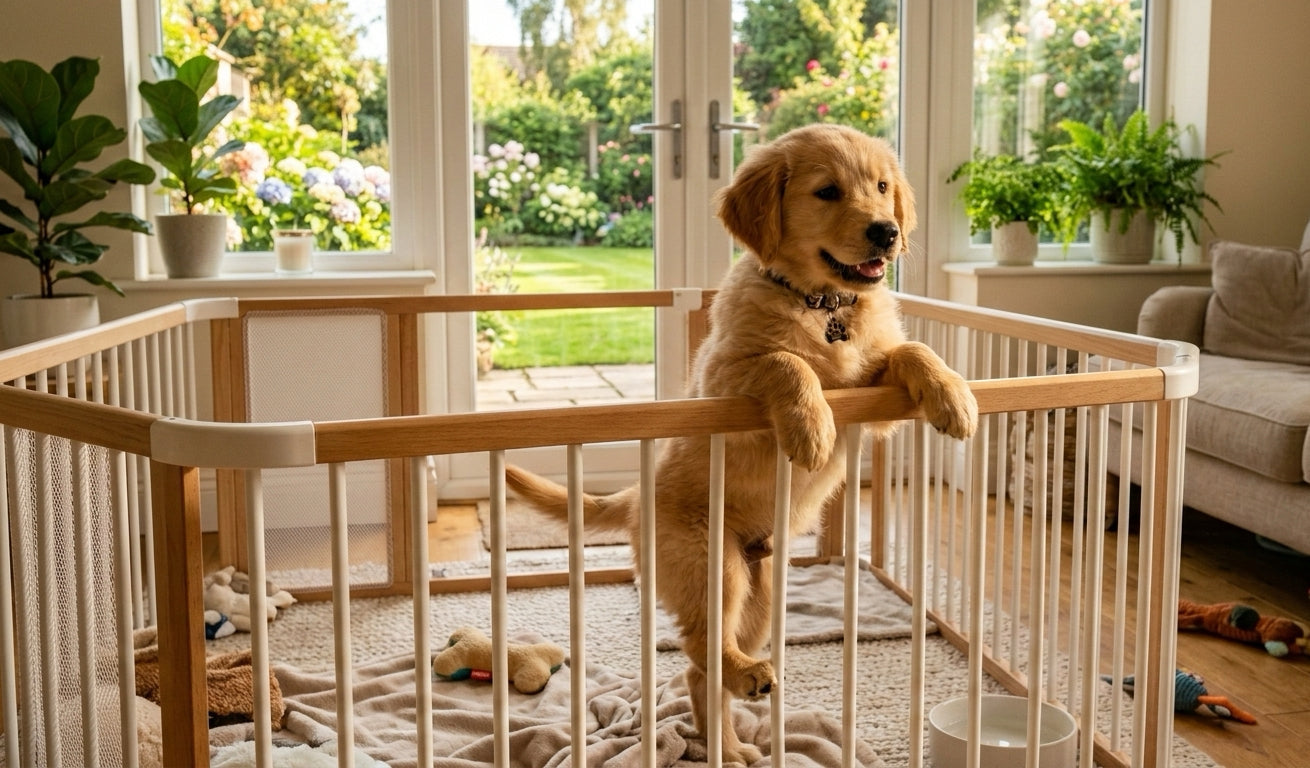
Common Mistakes That Make Puppies Try to Escape Playpens
If your puppy keeps trying to climb, push, or jump out of their playpen, it’s tempting to label them as “too hyper” or “too stubborn.”
But in most cases, escape attempts aren’t random.
They’re responses to environmental or training mistakes.
Understanding what triggers escape behavior can help you fix the root cause — instead of constantly upgrading containment without solving the real issue.
1. Not Providing Enough Physical Exercise
One of the most common reasons puppies attempt to escape is simple: excess energy.
Puppies need structured physical activity and mental stimulation to prevent unwanted behaviors such as jumping, chewing, and boundary testing.
When a puppy has energy stored up, the playpen becomes an obstacle — not a safe space.
Fix:
-
Schedule multiple short play sessions daily
-
Use enrichment toys inside the pen
-
Incorporate short training sessions before confinement
Even the most secure setup, whether it’s a metal exercise pen or an indoor modular system like the FXW Dog Playpen collection, won’t compensate for unmet exercise needs.
2. Leaving the Puppy in the Playpen Too Long

Playpens are tools, not long-term holding spaces.
The ASPCA notes that confinement without sufficient interaction can lead to frustration behaviors, including destructive chewing and escape attempts.
Young puppies especially have limited tolerance for isolation.
Fix:
-
Follow age-appropriate confinement time guidelines
-
Rotate toys to maintain novelty
-
Use playpens for short, structured intervals
3. Accidentally Reinforcing Escape Behavior
Here’s a subtle but powerful mistake.
If your puppy escapes and you react with:
-
Excited attention
-
Immediate freedom
-
A chase game
You may have just rewarded the behavior. Dogs repeat behaviors that are reinforced, even unintentionally.
A single “successful” escape can quickly turn into a learned strategy.
Fix:
-
Prevent early escape success with stable, well-secured panels
-
Avoid dramatic reactions
-
Calmly return the puppy without creating a game
Stable playpen designs — such as heavy-duty ground-anchored models or reinforced indoor panels from FXW — can help prevent those first successful breakouts.
4. Using a Playpen That’s Too Short
Many owners underestimate how high puppies can jump.
Some medium and large breed puppies can clear surprisingly tall panels, especially if motivated.
The Humane Society of the United States emphasizes proper containment height and stability to prevent injury from climbing or jumping attempts.

Fix:
-
Choose appropriate height based on adult size potential
-
Upgrade panels before escape attempts become frequent
-
Avoid stacking unstable extensions
For jump-prone puppies, taller FXW playpen models — including indoor options like the Auraspace design helps reduce climbing leverage while maintaining visibility.
5. Creating an Uncomfortable Environment Inside the Pen
If the playpen area feels boring, stressful, or uncomfortable, your puppy will try to leave.
Common environmental mistakes:
-
Placing the pen in a high-traffic chaotic area
-
No bedding or comfort surface
-
No enrichment items
-
Too much isolation from family activity
Puppies need to feel included, not excluded.
Fix:
-
Position the pen where your puppy can see you
-
Add a comfortable mat
-
Rotate safe chew toys
-
Use positive reinforcement when guiding them inside
Transparent or open-visibility designs can help reduce separation stress while maintaining safe boundaries.
6. Ignoring Breed Traits and Temperament
Not all puppies are wired the same.
Herding breeds, working dogs, and athletic mixes are naturally more persistent problem-solvers.
These puppies:
-
Test barriers
-
Look for weak points
-
Practice climbing
In these cases, lightweight or loosely connected panels may unintentionally invite testing.
Choosing structurally stable systems — such as reinforced metal exercise pens for outdoor use or modular indoor FXW playpens with secure connectors — helps eliminate obvious “challenge points.”
7. Making the Playpen Feel Like Punishment

If the playpen is only used when:
-
The puppy misbehaves
-
Guests arrive
-
The owner leaves abruptly
It can become associated with negative emotions.
That association increases resistance and escape attempts.
Fix:
-
Make the pen part of normal daily routine
-
Offer treats or rewards when entering
-
Avoid using it as discipline
The goal is neutral or positive association — not restriction.
Do You Actually Need a More Secure Playpen?
Before upgrading, ask:
-
Is my puppy under-exercised?
-
Am I reinforcing escape attempts?
-
Is the pen height appropriate?
-
Is the environment engaging?
If you’ve addressed those factors and escape attempts continue, then upgrading to a more stable, height-appropriate, and escape-resistant design can prevent injury and habit formation.
FXW’s range of dog playpens — from outdoor heavy-duty models to indoor modular and acrylic designs — are built with structural stability in mind, reducing common escape triggers caused by weak connectors or unstable panels.
Final Thoughts
Most escape attempts are not about defiance.
They’re about:
-
Energy
-
Environment
-
Reinforcement
-
Design flaws
By addressing these common mistakes first and ensuring your containment setup is structurally appropriate. You can significantly reduce escape behavior without creating stress for your puppy.
A playpen should feel like a safe, structured space, not a challenge to conquer.
Share:
Is an Escape-Proof Playpen Necessary for High-Energy Puppies?
How to Stop Puppy from Crying in Crate and Why Dog Playpen is the Better Alternative